
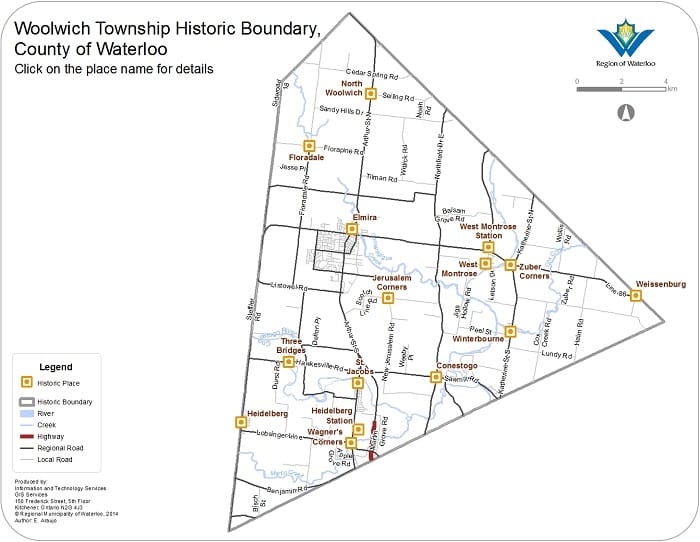
Woolwich Township was one of the earliest townships secured for settlement in Waterloo County. However, compared to that of other townships, the process of settlement was slow to begin. The earliest settler may have arrived in the Township as early as 1807, but the majority of settlement did not begin until the 1830s.[1] Although Woolwich Township settlers came from a variety of origins, in the early years the majority were of German-Mennonite heritage, most of whom came from Pennsylvania and Waterloo Township.[2] In general, they tended to settle west of the Grand River, while English (many of them Methodists) and Scots-Presbyterians settled to the east.[3] A large number of Woolwich Township settlers were farmers and small trades workers. The village of Elmira eventually grew around the farmlands, with settlement by immigrants of a variety of professions, trades, and businesses.
In the early settlement period, the bulk of immigrants into Waterloo County chose to settle in previously settled areas like Waterloo Township where settlement had begun as early as 1800.[4] For this reason, settlement in Woolwich Township was all but neglected for several decades. Moreover, when a noticeable amount of settlement did begin in the area, immigrants generally preferred to settle near the Woolwich-Waterloo township line where they would remain in close proximity to communities of Waterloo Township including Berlin. As Woolwich Township was increasingly settled along the southern township line, however, it became less dependent upon its southern neighbour. Consequently, new communities in the Township sprang up in its northern areas. Although the person who named Woolwich Township is not known, the Township was officially named in 1816 when it became part of the District of Gore.[5] It is commonly believed that it was named after Woolwich, in Kent, England.[6]
Before the influx of European settlement, Woolwich Township was an area of Grand River land included within Block Three (86,078 acres) of the Six Nations grant. This grant had been donated by the British to the Six Nations in the late eighteenth century for their loyalty to the Crown in the American Revolutionary wars. On behalf of the Six Nations, Joseph Brant sold Block Three to William Wallace, a carpenter from Niagara, in 1798. Wallace subsequently sold portions of Block Three to a number of people including Robert Pilkington, who purchased 15,000 acres of the Block's eastern front sometime before 1803.[7] This area became Pilkington Township of Wellington County. The remaining area of Block Three would become Woolwich Township. Although Wallace forfeited Block Three lands in 1806 for failing to honour his contract, Brant allowed him to retain 7,000 acres in the south-eastern corner of the Township. However, after siding with the Americans in the War of 1812, Wallace forfeited this portion of land as well. Subsequently, Wallace's land had to be resold.
William Wallace had received his Patent from the Crown for Block 3 on the Grand River (86,078 acres) on 5 February 1798. Subsequently, the Commissioner of Forfeited Estates sold 7000 acres of Wallace's forfeited lands to William Crooks on 6 November 1821. After that, William Crooks sold 7048 acres to the Honourable William Allan on 7 November 1822. William Allan (ca. 1877-1853) was a Scottish entrepreneur who was well known in Upper Canadian financial circles. He was a director of the Bank of Upper Canada and, as such, a member of the Family Compact. He was active in many land speculations such as the purchase of this part of Block Three in Woolwich Township. For more information about William Allan go to the Dictionary of Canadian Biography Online.
The German Company, originally formed for the purchase of the land in Waterloo Township, also bought a large area of forfeited land. They purchased 45,195 acres in the Township's western portion in 1807. This German Company purchase was led by Augustus Jones (a senior government surveyor), and John and Jacob Erb of Waterloo Township. German Company land was surveyed by Jones into 130 lots of about 350 acres each.[8] In 1821, William Crooks purchased the 7,000 acre area of land which Wallace had forfeited after the War of 1812. This area of land became known as Crooks Tract. Crooks divided the land and resold it in small parcels to incoming settlers, many of them from Scotland.[9] In 1807, two German Company men, Henry Brubacher and Benjamin Eby, returned to Lancaster County Pennsylvania with Jones's survey. They wished to promote the sale of the company's land among their fellow Mennonite compatriots, as had been done with Waterloo Township.[10] The success of settlement in Waterloo Township consequently encouraged Mennonite buyers to purchase lots in Woolwich Township.[11] Subsequently, in 1808, lots totalling 26,600 acres were purchased by Mennonite buyers alone, and within a short period, all were sold.[12] These buyers purchased between one and four lots each, or 350 to 1,400 acres. However, they did not settle on their lands as quickly as had done the previous settlers of Waterloo Township. Instead, many Woolwich Township land owners chose to settle in Waterloo Township where settlement had already taken place.
For this reason, early settlement in Woolwich Township was initially marginal and sparse. For example, by 1825, including the settlers of Pilkington's Tract, the population of Woolwich Township was only 84.[13] Moreover, the majority of early settlement hardly ventured beyond the border of Waterloo Township. These settlers were mainly Mennonite farmers from Waterloo Township who wished to remain near the communities from where they came. Settlement in or near Waterloo Township meant that settlers gained easier access to items like supplies, goods, and social support otherwise unavailable in the isolated areas of Woolwich Township.
From the early 1830s, settlers began to spill into Woolwich Township. Communities were formed first nearest the Waterloo-Woolwich border and later in northern areas. The population of the township increased steadily. In 1841, its population was 1009; and by 1850, it had reached 3501.[14] By 1891, including the population of Elmira, the Township reached a population of 5907.[15] By the early twentieth century, a wide variety of communities existed throughout the whole of the Township.
Several factors encouraged immigrants to settle in Woolwich Township. For example, it offered ideal farm conditions to settlers who wished to continue an agricultural existence. For this reason, it is not surprising that Mennonite farmers were the primary settlers in the Township. Secondly, Woolwich Township was an attractive source of water-power for industry and milling, with a number of rivers and creeks flowing through the Township, including the Grand River, the Conestoga River, Canagagigue Creek, and Cox's Creek. The rise of early industries in such communities as Elmira and St. Jacobs is an example of water-power forming the nucleus of many early communities.
The first known immigrant to have settled in Woolwich Township was an English military man named Captain Thomas Smith. Until the mid-1830s, little is known about him or his dealings in the area. However, he was a British Loyalist who arrived in the Township from Vermont State as early as 1807,[16] squatting along the east bank of the Grand River on William Wallace's property in the area of Winterbourne. Smith was the founding member of that community. He established a stage service there by the mid-1830s that ran to Berlin and Preston until about 1850. George Eby was another early settler. He was a Mennonite from Waterloo Township who settled in Woolwich in 1813. He cleared land on Lot Two of Germany Company land along the Woolwich-Waterloo township line.[17] A short time later, David Cress of Waterloo Township settled in the same locality.[18] Simon Cress and his family, relatives of David, were the first pioneers of the St. Jacobs area in about the same time.[19] He and his family built a log home along the Conestoga River. In the Conestoga village area, Henry Martin and David Musselman were pioneering settlers.[20] Henry Martin was the son and relative of Peter and David Martin respectively who both came from Pennsylvania and settled on German Company land in Waterloo Township.[21] In 1819-20, with their families, both Peter and David Martin followed Henry into Woolwich Township.[22] They settled in the northwest corner of the Township near the Waterloo-Woolwich line. Reminders of their presence in this area remain to this day, including the names Martin Creek and Martin's Grove.
From the 1830s, the pace of settlement in Woolwich Township increased considerably, and the basis of several of the township's communities developed. Three such communities included Winterbourne, Conestoga, and St. Jacobs, becoming centres of trade, services and worship for farmers from the surrounding areas. Winterbourne was mainly an English and Scottish settlement. As was mentioned earlier, Thomas Smith was its first settler. Both Presbyterian and Methodist congregations were established there at this time.[23] Winterbourne was also home to the first post office in Woolwich Township.[24] Although the exact date that the post office was first opened is not accurately known, it was opened sometime before 1842 and possibly as early as 1834 with the arrival of its first post master, John Davidson. In the early 1850s, a settler from England, Thomas Lanphier, built a dam across Cox Creek, providing power for both a flour mill and a sawmill.[25]
Conestoga and St. Jacobs were primarily Germanic settlements. The earliest of these settlers were predominantly Mennonite, but later settlers included German Roman Catholics and Lutherans.[26] Conestoga was founded by David Musselman, who purchased land on which the community was founded in 1830. He was the first settler of the area and by 1840 had built a sawmill on Spring Creek. It was the first sawmill of the community and possibly of Woolwich Township.[27] In 1844, he dammed the Conestoga River and built the Township's first flour mill, and his second sawmill.[28] Although it is likely that a number of immigrants settled in Conestoga during the 1830s, little is known otherwise. However, after Musselman established several enterprises there, the community quickly expanded.[29] By 1850, it had reached a population of about 70 and consisted of a grist mill, a sawmill, and a chair factory.[30]
Similarly, St. Jacobs was founded as early as 1830.[31] However, as much as can be determined, little settlement occurred there until the early 1850s. At this time, it was the industrial ventures of Jacob Snider that seemed to encourage the community's rapid but short-term growth. In 1851, Snider built a dam there to power several mills. By 1852, he had in operation a sawmill, a woolen mill, and a flour mill.[32] These mills not only provided employment but also attracted further settlement in the area. In the same year, a number of stores, a cooperage shop, and a post office were opened for business. By 1855, the population had swelled to about 400 inhabitants.[33] By 1857, a formal plan of settlement had been adopted in hope that St. Jacobs would receive railway connection to the Grand Trunk line that arrived in Waterloo County in the mid-1850s.[34] The railway line was not built until 1891, and the village's population remained stable during these years.
Once the phase of early settlement was completed, communities in northern areas of the Township developed apace. Elmira, for example, would later become one of the leading centres of business in Woolwich Township. It was founded as early as 1834 by Edward Bristow (Bristow's Corners).[35] Although some growth took place from this point in time, it remained marginal until 1856 when Elmira was formally laid out for settlement by Joel Good, the major landowning settler of the area.[36] The extent of its earliest growth is not known, but by 1869, it had reached a population of about 450, and in 1891, about 1069.[37] North of Elmira, Floradale was established as a post village for the surrounding rural area. The earliest industrial development appeared in Floradale in the form of a dam and mill-race by about 1855, and a flour mill and sawmill by about 1860.[38] By the turn of the twentieth century, its population reached 400.
By the time the Grand Trunk Railway arrived in Waterloo County during the mid-1850s, Woolwich Township had developed not extensively, but quite noticeably. However, Woolwich Township was not included along any railway connection until 1891, when a branch of the Grand Trunk was laid from Waterloo to St. Jacobs and Elmira. In 1907, it was also a connection on the Canadian Pacific line running east and west through the township. By the time these railways were laid, the boom of the early railway days had long since past. For this reason, comparable industrial development to that of Waterloo Township and North Dumfries Township was never attained in Woolwich Township. Therefore, it is not surprising that the economic basis of the Township remained primarily agricultural in nature. However, despite being bypassed by the railway boom and large-scale county industrialization, Woolwich remained an important farming centre within Waterloo County. Its blacksmiths, tanners, merchants, hotels, mills, tailors, butchers, and manufacturers provided the township with the material support it required for the continuance of an agricultural existence. The presence of the conservative Old Order Mennonites and other conservative Mennonite groups endured in Woolwich, creating a unique rural character for which the township is still renowned.
Although the Township would continue to grow and develop into the twentieth century, especially the incorporated village of Elmira, in general its development was relatively marginal. Essentially, from the 1860s to the end of the century, the majority of communities in Woolwich Township including Winterbourne, Conestoga, and St. Jacobs had grown none or little at all. For the most part, they remained small trading centres for the surrounding farms. In fact, other than continual growth in Elmira, the population of Woolwich Township remained relatively stable until the middle of the twentieth century.[39] Growth since this time has resulted primarily from Woolwich Township becoming a destination for commuter families to Kitchener-Waterloo and other surrounding industrial centres.
[1] Geoffrey Hayes, Waterloo County: An Illustrated History (St. Jacobs, 1997), 12. See also: "Notes on the Pioneer Days of Woolwich Township," Waterloo Historical Society, (1947), 39.
[3] "Notes on the Pioneer Days of Woolwich Township," Waterloo Historical Society, (1947), 39-40. See also: Hayes, 12.
[4] Virgil Emerson Martin, The Early History of Jakobstettel: An Account of the People in and around St. Jacobs, Ontario...to the Beginning of the Twentieth Century, (St. Jacobs Printery Ltd: St. Jacobs, 1979), 32.
[5] Waterloo Township through Two Centuries (St. Jacobs: 1995), 95.
[6] Alan Rayburn, Place Names of Ontario, (University of Toronto Press: Toronto, 1997), 381. See also: W.J. Wintemberg, "Origin of the Place and Stream Names of Waterloo County, Ontario," Waterloo Historical Society, (1927), 354; and G.H. Armstrong, The Origin and Meaning of Place Names in Canada, 1st ed. 1930 (Macmillan of Canada: Toronto, 1972), 309.
[8] Hayes, 7; and "Notes on the Pioneer Days of Woolwich Township," Waterloo Historical Society, (1947).
[9] W.V. Uttley, "Woolwich Township-Its Early Settlement," Waterloo Township, (1933), 13.
[12] Uttley, 11. See also: L.J. Burkholder, A Brief History of Mennonites in Ontario, (Markham, 1935), 42.
[13] W.H. Smith, Canada: Past, Present and Future, Volume 2, Mika Publishing, Belleville (reprinted, 1974), 115-16.
[15] Census of Canada, 1890-91, (S.E. Dawson: Ottawa, 1893).
[17] Parsell, Illustrated Atlas of the County of Waterloo, (1881).
[19] Ezra E. Eby, A Biographical History of Early Settlers and Their Descendants in Waterloo Township, two volumes, 1st ed. (Berlin, 1895, 1896), 2nd ed. Ed. Eldon D. Weber, (1971), 115-16.
[24] W.H.E. Schmalz, "Postal History of Waterloo County," Waterloo Historical Society, (1968), 71. See also: Uttley, 18.
[27] Martin 43. See also: "Township of Woolwich," Waterloo Historical Society, (1961), 53.
[35] Souvenir of the Elmira Old Boys and Girls Reunion, Souvenir Booklet Committee, (1948), 2.
[36] Souvenir of the Elmira Old Boys and Girls Reunion, 2.
[37] Province of Ontario Gazetteer and Directory, C.E. Anderson &Co. (1969), 424; and Census of Canada, 1890-91, V.1, (S.E. Dawson: Ottawa, 1893).
[38] Allen D. Martin, "Mills At Floradale-Past and Present," Waterloo Historical Society, (1981), 94.


