
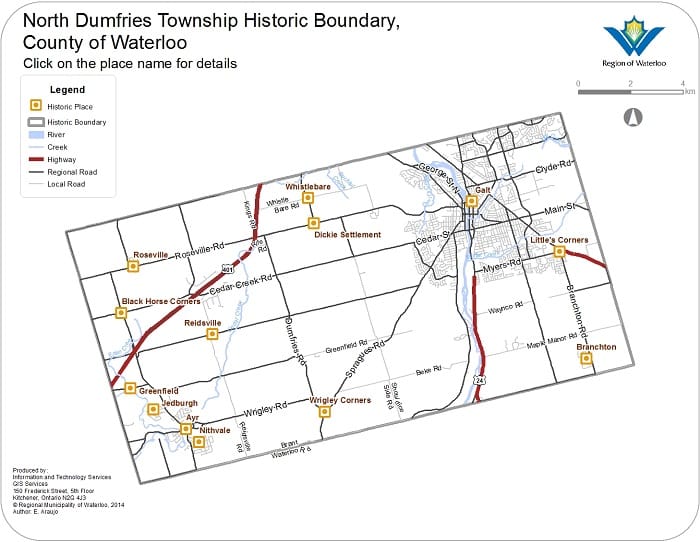
In 1816, when the area of Grand River land known as Block One became part of the Gore District, it was named Dumfries Township. Block One had originally been part of a larger tract of land donated to the Six Nations during the late eighteenth century for their loyalty to the British Crown in the American Revolutionary wars. On behalf of the Six Nations, Joseph Brant sold Block One (94,035 acres) to Philip Steadman in 1795. Steadman died in 1799, and Block One switched ownership several times over the next number of years. It was finally purchased by William Dickson in 1816, who named the township Dumfries after his hometown in Scotland.

Girl in Scottish Costume, Aged Six,
1914. DHC 974.094.231
In 1849, the Baldwin Municipal Act was passed, enabling the creation of a revised county system; with the subsequent Hincks Act of 1852, Waterloo County was created. After a number of political battles over how the boundaries of Waterloo County should be defined, Dumfries was divided into two halves: north and south. Only North Dumfries was included as a township of Waterloo County along with the townships of Waterloo, Wilmot, Wellesley, and Woolwich. At the same time, South Dumfries became a township in Brant County.
William Dickson had emigrated to Quebec in 1785, later becoming a successful and wealthy lawyer and merchant in Niagara. After purchasing Block One, Dickson set out with Absalom Shade, a twenty-two year old carpenter from Pennsylvania, to appraise the area in an effort to decide on the best site for settlement. After trekking on horseback from Niagara along the Governor's Road, a military and commercial roadway completed by 1795, Dickson and Shade were led north along the Grand River by an First Nations guide until they reached the abandoned ruins of Alexander Miller's mill near the confluence of Mill Creek and the Grand.[1] They decided that this location, now the present area of Galt, would be best suited for settlement.
It was agreed that once things at home in Buffalo were arranged, Shade would return to rebuild and expand the old mill while managing the surrounding area on behalf of Dickson. By 1919, Shade had completed the building of both the grist and saw mills which became known as Dumfries Mills. Although it has been said that Shade was in the possession of only $100 and a carpenter's chest when he returned from Buffalo to Dumfries, he would later become one of the wealthiest and most influential merchants, entrepreneurs, and politicians in the early years of Galt and Dumfries Township.[2]
The construction of the Dumfries Mills attracted a number of people who settled in the area within a few years. By 1819, a bridge over the Grand River was completed, and one year later a distillery was established.[3] In 1821, a tavern was built, and by 1824, the "Red" store of Absalom Shade began what would be a domination of the local merchant trade which would last until about the middle of the 1830s.[4] This area of settlement became known as Shade's Mills. As an increasing number of settlers arrived elsewhere in the township after 1816, farms and settlements were established further afield in the township.
In 1819, despite the township's small population, a township meeting was held. This was the first of its kind held among any of the townships of Waterloo County.[5] At this meeting, a number of administrative positions, including both township clerk and warden, were assigned to local individuals for the governing and managing the township.[6] Attention was also given to the issues of fencing and of branding livestock which resulted in the standardization of both. The precedents set by this meeting no doubt later contributed to the organized and uniform fashion in which Dumfries Township developed. From a modern perspective, although this meeting addressed issues that were seemingly trivial in nature, it may have set an early example for the later development of municipal government in the township, and even the county.
Dumfries Township, surveyed by Deputy Provincial Surveyor Adrian Marlett, was one of the most uniformly laid-out township of Waterloo County.[7] It was divided into twelve concessions, twelve miles in length and one mile apart. The majority of its plots each contained 200 acres of land.[8] Unlike other townships at the time, the survey provided allowances for the construction of roads and paths. Although it did not provide such space along its four outer township lines, allowance was provided between each concession and every sixth lot.[9] As a result, when roads were built throughout the township, they generally followed a symmetrical pattern which was organized and logical. For this reason, although roads and highways were initially slow to expand and develop, the landscape of the township developed smoothly and coherently.
The initial settlement of the township was rather slow. In 1818, including those settlers of Shade's Mills, of whom there were 38; only 63 people resided in the township.[10] Significant settlement of the township did not begin in earnest until the later years of the 1820s. Many of the township's first settlers, who tended to settle in its northern parts, came from Waterloo Township. Because settlement was slow to get underway, Dickson hired John Telfer, a Hudson Bay Company deserter, to promote and encourage Scottish groups to settle in the area.[11] Telfer's efforts were successful, and Scottish immigrants arrived in substantial numbers. At first they were concentrated in the area immediately surrounding Shade's Mills, but later settled in more outlying areas. Moreover, the majority of these settlers were Presbyterians, shaping a unique cultural atmosphere in this township. Despite the township's predominantly Scottish and Presbyterian population from the 1820s onward, a small number of Pennsylvanian Mennonite settlers from Waterloo Township also bought land and settled in North Dumfries. They settled mainly in the northern reaches of the township in the vicinity of Roseville.[12]

John Shiel and Old School House on
Spragues Road, North Dumfries Township, ca. 1910.
DHC 971.099.007
In 1827, John Galt, acting Commissioner of the Canada Company and a previous school companion of Dickson, arrived at Shade's Mills.[13] He put into action the construction of a road between Shade's Mills and Canada Company land in the area north and east of Shade's Mills that would become Guelph. Settlers of Dumfries Township found employment in the development of this project which also entailed the clearing of land for the village of Guelph. The construction of this roadway released the township from its previous isolation. The township could now access, if at least minimally, outlying areas within and without the township. During this time, the first post office of the township, located at Shade's Mills, was established. Dickson, in honour of John Galt, named the post office Galt.[14]
In 1853, Galt became an incorporated village, administered separately from the affairs of the township. It was however the economic and cultural centre of the township area as it grew from village to town to city. Galt was amalgamated with Hespeler and Preston in 1973 to form the present day City of Cambridge. The former areas of Galt, Hespeler and Preston, however, are still presently referred to as such by many local residents of Cambridge.
By the 1830s, the township had grown substantially in size and was developing steadily. In 1834, although settlements were not concentrated, the population of the township had reached about 4, 177, and the population of Galt had reached about 250.[15] By this time, Galt and Ayr, the two main villages in the township, had developed a number of enterprises including grist, flour, and saw mills, distilleries, stores, taverns, and farmsteads. Moreover, there were a number of social institutions which had begun to blossom in their early forms including schools, churches, township halls, libraries, clubs, and in Galt, a debating society.
Roadways and transportation had not yet developed beyond their minimal potential. Moreover, the Beverly Swamp blocked the path between Hamilton and Dundas and the fertile lands of both Waterloo and Dumfries Townships.[16] As a result, communities in North Dumfries Township remained relatively isolated from one another, as well as from others in distant townships. Improved transportation and communication routes were an urgent necessity.
In 1831, experimenting with alternative transportation methods, Absalom Shade attempted to float farm produce down the Grand River to Dunnville on wooden stages which were known "Arks."[17] From Dunnville, goods could be towed through the Welland canal, which had just recently been constructed, to Lake Ontario where they could be shipped to markets beyond. Shade's stages were large and bulky. In order to avoid the numerous shoals, islands, and rocks in the river, the stages had to be floated down the Grand River during spring floods. Although some settlers were skeptical of Shade's ability to navigate these unwieldy stages down the Grand, Shade managed to transport his goods fairly successfully-albeit, not without a tremendous effort, a crew of hard working men, and one inconvenient mishap in the last of the three years the stages were used.[18] This mishap occurred when one of Shade's stages ran aground. The goods were saved from disaster however, when another stage was built and sent down the river the following day. It may have been this mishap that convinced Shade that less difficult methods of transportation were preferable.[19]
It was not until the macadamized road between Dundas and Waterloo was completed in the later 1830s, that people from both the township and the county felt safe crossing the Beverly Swamp. The Beverly Swamp had been feared for decades because of its deep bog-holes and impenetrable wetlands. The completion of the Dundas and Waterloo road across the Beverly Swamp spurred the township's growth and development throughout the 1840s, and up until the coming of the railway in the 1850s.
In 1836, William Dickson had returned to Niagara for good, residing there until his death in 1846. Dickson left his son William Dickson Jr. to carry on the family's businesses in both Galt and in the township. Before Dickson left Dumfries Township however, one the greatest terrors ever to strike the Township occurred. In 1834, the first symptoms of cholera appeared in a traveling entertainer passing through Galt. A short time later, the town's worst fear came true when the cholera spread through the population. Although the contagion spread throughout the township and county quite rapidly, it has been suggested that Galt was most heavily hit of all communities, losing as much as one-fifth of the village population.[20] Dr. John Scott, then a recent immigrant from Scotland, was one of the leading members of the community aiding the fight against the disease. His role in Galt against cholera established his reputation as a medical doctor and public figure.[21] Ironically, in the battle between Galt and Berlin to win County seat during the early 1850s, he would be Galt's strongest opponent, and Berlin's leading advocate.
The decision in 1853 to split Dumfries Township gave Berlin an advantage in the battle over the county seat: Berlin was now located at the centre of the county. Moreover, despite Berlin's small population of about 750 in comparison to about 2200 in Galt,22] and despite the fact that it was not yet an incorporated village, it received the support of several prominent men in the county including Dr. John Scott, who had by now become a well known politician in Berlin, and Frederick Gaukel, a hotel-keeper, who donated land for the construction of a county courthouse and jail in Berlin. The influence of a powerful establishment in Berlin, subsequently gave it the edge to win the Waterloo County seat. Over the next 120 years, this municipal framework would remain in place until County reorganization was officially implemented in 1973 and the Regional Municipality of Waterloo was implemented.
At the same time that the political battle for the county seat took place, North Dumfries Township had developed a thriving economy and culture. In 1841, the population of North Dumfries was 6,129; by 1851, it had reached 7,316, second only to that of Waterloo Township which had a population of 7,759.[23] A network of roads and highways had been constructed and improved, connecting outlying settlements to the central villages of Ayr and Galt. Log houses and buildings had been replaced increasingly by frame and stone structures. Social institutions including churches and schools had evolved into stable organizations. A variety of businesses and industries were flourishing, especially in production of grain for export, which was the leader in Waterloo County. At this time, Galt had a population of well over 2000 inhabitants and was the market centre of rich agricultural land.[24] It was the most developed and booming village in the township and the county, becoming an incorporated village in 1850. However, losing the county seat meant that Berlin would receive mainlines when the tracks of the Grand Trunk Railway were opened in 1856.
Its position on the mainline was a major factor contributing to Berlin's prosperity and growth which continued to be the greatest in the county. Although Galt and North Dumfries were subsequently excluded from the Grand Trunk railway's mainline, it did receive branch lines during the 1850s that contributed to its growth and sustenance. In fact, the first train to ever enter the county, in 1854, was laid from Harrisburg in Brant County north to Galt through North Dumfries Township.[25] The Credit Valley Railway (later part of the Canadian Pacific Railway) connected Ayr and surrounding rural areas to markets abroad from the 1870s onward. In all Waterloo County, North Dumfries' farmers and millers benefited the most from railway connection during the 1850s.[26] The railways allowed North Dumfries to reach grain markets abroad, furthering development of its agricultural and milling enterprises. In Ayr, John Watson began producing agricultural machinery by the late 1840s. Two decades later, his equipment could be found not only throughout the township and the county, but also throughout Canada.[27] By the 1860s, a greater variety of farm produce was grown for export, especially wheat and oats.

R.G. Arthur's Barn Raising Near Branchton,
North Dumfries Township, 1912. DHC 985.046.002
Farming seemed to be a natural inclination for Dumfries Township. Wheat and other grains had been shipped from Galt since the 1840s, whereas Berlin did not establish itself as a supplier until over a decade later.[28] Moreover, the township had a flourishing agricultural society since 1839. The Dumfries Agricultural Society was the first of its kind in the county, providing the stimulus for the development of local and national markets among its membership.[29] Although Galt's market square was not built until 1857, farmers' markets were active during the 1840s. Although Galt was not on a main railroad line, it remained competitive economically with Berlin, which did not surpass Galt until the late nineteenth century. Galt remained one of the most flourishing towns of the County, becoming known as the "Manchester of Canada" with its many heavy machinery and textile factories. Because of its agricultural excellence and the prominent enterprises found in Galt and other such communities, including Ayr and Greenfield, North Dumfries remained one of the most prosperous and vibrant townships in the County.

Stone Farmhouse, North Dumfries Township, ca. 1905.
DHC 990.016.010
North Dumfries Township was transformed both technologically and socially by the turn of the twentieth century. Not only did there now exist an elaborate network of rails, roads, and factories, but also a well formed system of schools, churches, health facilities (including a hospital in Galt built in the 1890s), and cultural societies. The first hamlets of settlement had since changed to villages, and villages to towns. No longer were settlers isolated; now roads and railways made them neighbours within a larger social structure and organization. Although Galt and North Dumfries remained somewhat on the periphery of economic and political life of Waterloo County that was centered in Berlin, it has kept a strong and cohesive identity based on its roots in agriculture and the unique individualism of its founding Scottish peoples.
[1] Andrew W. Taylor, Our Todays, and Yesterdays, A History of the Township of North Dumfries and the Village of Ayr, (1967), 24.
[2] Geoffrey Hayes, Waterloo County: An Illustrated History (St. Jacobs, 1997), 8-9.
[4] Young, 110. See also: Hayes, 9.
[5] "Township of North Dumfries," Waterloo Historical Society, (1960), 34. See also: Young, 134.
[7] James Young, Reminiscences of the Early History of Galt and the Settlement of Dumfries in the Province of Ontario (Toronto: 1880), 20. See also: Taylor, 29. See also: Hayes, 8.
[8] J. David Wood, "The Stage is Set: Dumfries Township, 1816," Waterloo Historical Society, (1960), 40. See also: Hayes, 8; Taylor, 29.
[12] E.G. Barrie, "North Dumfries Centennial Address," Waterloo Historical Society, (1952), 43.
[13] J.P. Jaffray, "Blazing the Trail In Dumfries," Waterloo Historical Society, (1926), 235.
[14] Jaffray, 235. See also: Young, 49.
[20] Hayes, 15. See also: Young, 99.
[22] W.H.E. Schmalz, "Postal History of Waterloo County," Waterloo Historical Society, (1968), 55.


