
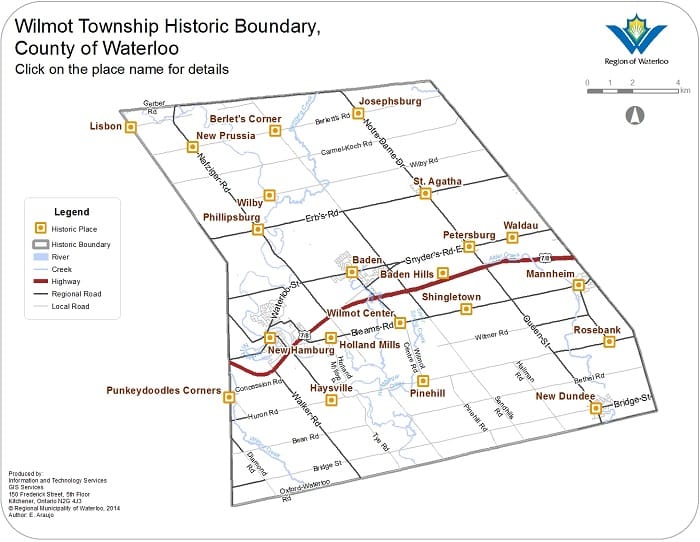
Compared to that of other townships in Waterloo County, the settlement of Wilmot Township occurred very quickly. Settlement of the township began in 1824, and it is commonly believed that the township was essentially settled in just twenty years.[1] This was in part due to the development of an organized roadway system which provided easy access to supplies and goods in the previously developed townships of Waterloo County. Wilmot Township was originally an area of land comprised of Crown and Clergy Reserves. It was not one of the blocks of land contained in the Six Nations grant from which the townships of Woolwich, Waterloo, and North Dumfries were created. Wilmot Township comprised of three tracts of horizontally divided land: the German Block, Block B in the north, and Block A in the South. The German Block was controlled by the Crown. It was settled primarily by immigrants of German heritage (by which influence it acquired its name) including those from Pennsylvania, Europe, and Waterloo Township. Blocks A and B to the south and north of it, respectively, were controlled by the Canada Land Company. Although Blocks A and B were also settled by immigrants of German heritage, they were part of a mix of other immigrants of Scottish, English, and Irish origins who also settled in these areas. When Blocks A and B were acquired by the Canada Land Company in 1825, they were incorporated with the German Block and given the name Wilmot Township.[2] The Township most likely received its name from Sir Robert John Wilmot-Horton who was Under Secretary of State for War and the Colonies in Lord Liverpool's administration.[3] Moreover, Wilmot-Horton was also involved with the Canada Land Company when it purchased Blocks A and B.
The earliest settlement of Wilmot Township occurred in the German Block. This area of land was prepared for settlement by the work of Christian Nafziger, an Amish Mennonite from Bavaria, Germany. Nafziger first came to Pennsylvania in 1822 with the intent of purchasing land for a large number of Amish families in his homeland. Discovering that land in Pennsylvania was too expensive, he moved on to Upper Canada where he learned that land was cheaper. With the aid of several Pennsylvania German Mennonites from Waterloo Township, including Jacob Erb and Jacob Snider, Nafziger applied to the Lieutenant-Governor of Upper Canada for a large grant of land which could be settled by a large number of his people.
Nafziger subsequently secured the German Block which was later divided into 200 acre lots and sold to willing settlers. According to this deal, settlers were to receive fifty acres of each lot free if they built both a house on their property and cleared the land along its front for the development of three roadways through the Block.[4] After securing this deal, Nafziger returned to Germany where he received its official confirmation from most likely the Duke of York.[5] Although Nafziger did not return from Germany until 1826, his land dealings had set in motion the settlement of the German Block which began in 1824.
The first settlers to arrive in the German Block were Amish Mennonites. Amish Mennonites took their name from Jacob Amman, a Swiss Mennonite leader who established a branch of the Mennonite church in the late seventeenth century.[6] From the mid-1820s to the early 1830s, a number of Amish Mennonite groups associated with either Mennonites in Waterloo Township or Nafziger in Europe settled in the German Block. These groups came from areas in both Pennsylvania and Alsace-Lorraine, (an area where the north-east of France and Germany meet along the Rhine River), settling primarily in the Petersburg-Baden locality.[7] Immigrant groups from Pennsylvania began settling in the area during 1824, and those from Europe in 1826. By 1829, 130 Amish settlers had claimed lots in the Township. Fifty-eight of these were from Pennsylvania, sixty-six from Europe, and the remaining six of other heritage.[8] By 1830, Wilmot Township had reached a population of 1,272 and had scarcely been settled by immigrants other than those of the Amish faith in the German Block.[9]
Coinciding with the settlement of the German Block was the development of three horizontal roads that had been part of Nafziger's land deal. Allowances for these roads were made in a survey of the Block undertaken by Deputy Surveyor John Goesman just prior to settlement in 1824. Settlers undertook the development of the roads, completing them by the early 1830s.[10] Running east to west, they were located between every two of the six concessions, passing through Wilmot Township into Waterloo Township where there was access to three mills. They included: the Upper Road which led to Abraham Erb's mill (subsequently called Erb's Road); the Middle Road which led to Joseph Schneider's mill (Snyder's Road); and the Lower Road which led to Philip Bliehm's mill (Bleam's Road). These roads not only provided an immediate means and incentive for the settlement of the township, but also a blueprint for its development. Because they provided direct access to neighbouring townships and to mill sites previously established in Waterloo Township, settlers of Wilmot Township could acquire more easily the supplies and goods they needed for establishing their own settlements.[11] Such advantages had not been available to the earlier settlers of Waterloo County where development was restricted for many years by the confines of isolation.
Although the majority of immigrants into the area by the early 1830s were of German heritage, the basis of a diverse cultural persona had begun to develop. This was in part due to the efforts of the Canada Land Company. This company was organized in England in 1824. After purchasing Huron Tract lands, it discovered that sections of it were swampy and useless for settlement. In compensation, the Company was given Blocks A and B from the Crown. The Company's primary aim was to promote English, Scottish, and Irish settlement in its lands.[12] In doing so, it constructed another large roadway through Block A, which became known as the Huron Road. It was blazed from Guelph to Goderich in 1828, and connected with other roads to stretch from Lake Ontario to Lake Huron. This roadway was the first to provide communication between the two lakes. It was the dominant roadway for business and travel through Waterloo County and Upper Canada until the railway was built there in the mid-1850s.[13] As with Upper, Middle, and Lower Roads, Huron Road significantly increased the Township's accessibility to outlying areas which contributed to its speedy settlement. Although only a small Anglo-Saxon population would settle in Wilmot Township in the 1830s, particularly in the southern third of the township, the building of Huron Road helped lay the foundations for all immigrant groups into the area.

Threshing Crew, Wilmot Township, ca. 1914. DHC 984.067.012
From the early 1830s, a number of immigrant groups settled in the township. Anglican and Methodist immigrants from the British Isles established themselves mainly in the Block A-areas of Haysville and New Dundee. From the mid-1830s, a large number of Roman Catholic immigrants from Alsace Lorraine settled in areas of the German Block and Block B, including St. Agatha (which became the centre of Catholicism in Wilmot Township), New Prussia, and Josephsburg.[14] German Lutheran immigrants also settled in a number of communities throughout the township, including St. Agatha, New Dundee, and New Hamburg. Another group of settlers to the area were second and third generation Mennonites from Waterloo Township. They brought pioneer experience, expertise, and capital to the township which no doubt contributed to its timely settlement.[15]
In the 1830s and 1840s, other settlements developed along the four major roadways. For example, the settlements of Philipsburg and St. Agatha developed along Erb's Road; Baden and Petersburg developed along Snyder's Road; New Hamburg and Mannheim developed along Bleams Road; and Haysville and Rosebank developed along Huron Road. Because these roadways provided the best transportation and communication links to outlying areas, settlement along them was practical and desirable, especially since the majority of road clearing was undertaken by settlers themselves. However, settlements were also founded in areas located elsewhere. New Dundee, for instance, which was one of the most prominent settlements in the township at the time, was founded in the south-east corner of Block A. However, a road connecting the two locations most likely contributed to New Dundee's continued settlement and sustenance.

Mr. and Mrs. Habel, Wilmot Township, ca. 1876. DHC 978.065.001.21

Mr. and Mrs. Mogk, Wilmot Township, ca. 1876. DHC 978.065.001.17
The majority of early immigrants in the township were farmers. The existence of a rich agricultural potential in the area attracted settlers, like the Amish, who wished to develop farmsteads as a means to continue their traditional way of life. Moreover, the existence of the four major roadways through the township, especially Huron Road, offered a means by which farm produce could easily reach markets. As well, a significant number of immigrants to the township were tradesmen and artisans. The German Lutheran immigrants of New Hamburg, for example, were carpenters, shop keepers, inn keepers, merchants, and millers.[16] Furthermore, a number of waterways existed including Smith's Creek (now the Nith River), Alder Creek and Spring Creek which could be utilized to provide power for the running of mills. For example, Joseph Goldschmidt and David Kropf had built sawmills by 1831, and Josiah Cushman both a gristmill and sawmill by 1837.[17]
By 1850, Wilmot Township had grown to a population of about 4, 863.[18] The majority of available land had by this time been claimed by settlers, and the township possessed a number of thriving communities. Settlers had cleared land and built houses, established farmsteads, mills, and distilleries. They had established a number of secondary businesses including stores, shops, and inns. They had built a network of both local roads and township roads. And they had established a number of schools and church meeting places. Although the majority of settlers were farmers, a number of industrial communities had also developed. New Hamburg, for example, was an industrial community with a population of about 500 in 1850.[19] The population of Berlin a year later was only 750. When the Grand Trunk Railway arrived in Waterloo County in the mid-1850s, New Hamburg was one of the most vibrant communities in the area.

Uriah Snyder Saw Mill Outfit at Fried's Woods, ca. 1905. DHC 2003.514.018
The Grand Trunk Railway arrived from Toronto through Berlin to Wilmot Township in 1856. Three settlements in the township received railway stops including Petersburg, Baden, and New Hamburg. Railway building was a huge source of employment for settlers of the township, as well as for workers from other townships who moved into the area for this reason. Moreover, in anticipation of the railway boom, many settlers developed enterprises along the railway's intended path. Jacob Beck of Preston, for example, moved into the Baden area during the early 1850s. At this time, the only community that existed in the area was a small hamlet known as Weissenburg which had been established amongst several farms. Beck purchased 200 acres of land there which he had surveyed and laid out for settlement.[20] He built several mills in the area by 1855, and renamed the community Baden after his hometown in Germany.[21] Before long, Baden grew into a lively industrial centre. For example, by 1864 it possessed several flour mills, a flax mill, an iron foundry, two sawmills, a number of general stores, a distillery; and a pail, tub stave, and heading factory.[22] The railway played a significant role in the industrial development and success of this village. Other settlements too developed substantially during the railway boom, including New Hamburg. For example, in 1858, New Hamburg had reached a population of 1000 and had become an incorporated village. Industry there had grown significantly and it housed two German newspapers, a substantial number of mills and factories, several general stores, and eight taverns.[23]
However, the railway had substantially less of an impact on the industrial growth of Wilmot Township than it did on other townships of Waterloo County. For example, by 1906, no village in the township had surpassed a population of about 1,300 and between 1891 and 1911, the population of the township had decreased noticeably.[24] The majority of population growth and industry had taken place during the railway's construction in the 1850s. However, after the railway boom subsided, little industrial growth took place.
Instead, the railway contributed to the growth and sustenance of farming in the township which became the dominant economic foundation and social fabric of its people. The railway opened markets locally to which farmers could sell their produce, and offered the means by which farmers could export their products on a large scale. Wheat markets in the township were first stimulated by British demand during the Crimean War in 1854 and 1855.[25] Later, the railway helped sustain or create many other markets. By the turn of the century, other than a little industry found in New Hamburg, Baden, and New Dundee, the citizens of Wilmot Township were by all means a farming populace. Today, Wilmot Township is still home to a large farming community including Amish and Mennonite farmers who depending on their level of conservatism have adopted a variety of modern farming technology.
[1] Ontario Agricultural Commission 1881. See also: Lorna L. Bergey, "A History of Wilmot Township," Waterloo Historical Society, (1962), 59.
[2] 1881 Ontario Agricultural Commission. See also: Lorna L. Bergey, "Lands and Peoples of Wilmot Township," More Than A Century In Wilmot Township, Historical Committee of the New Hamburg-Wilmot Township Centennial Committee, (1967), 15.
[3] W.J. Wintemberg, "Origin of the Place and Stream Names of Waterloo County, Ontario," Waterloo Historical Society, (1927), 353. See also: Alan Rayburn, Place Names of Ontario, (University of Toronto Press: Toronto, 1997), 375-76.
[4] E. Reginald Good, Frontier Community to Urban Congregation , First Mennonite Church, Kitchener 1813-1988, (Kitchener: 1988):14. See also: Geoffrey Hayes, Waterloo County: An Illustrated History (St. Jacobs, 1997), 11.
[5] Orland Gingerich, "Amish Pioneers," More Than A Century In Wilmot Township, Historical Committee of the New Hamburg-Wilmot Township Centennial Committee, (1967), 18; and Catherine Schumilas and Joan Williams, St. Agatha, 1867-1967, (1967), 10.
[7] Lorraine Roth, The Amish and Their Neighbours: The German Block, Wilmot Township, 1822-1860, Mennonite Historical Society of Ontario, (1998).
[9] Florence Diamond, "Wilmot Township Municipal History," More Than A Century In Wilmot Township, Historical Committee of the New Hamburg-Wilmot Township Centennial Committee, (1967), 6.
[12] Bergey, "A History of Wilmot Township," 51.
[13] Waterloo Historical Society (1917). See also: Bergey, "Lands and Peoples of Wilmot Township," 16.
[14] Catherine Schumilas and Joan Williams, St. Agatha, 1867-1967: Commemorating Canada's Centennial, ed. Don Collins, (1967), 3.
[15] Bergey, "Lands and Peoples of Wilmot Township," 16.
[18] W.H.E. Schmalz, "Postal History of Waterloo County," Waterloo Historical Society, (1968), 55.
[19] Ernest F. Ritz, "New Hamburg 1850-1860: A Period of Rapid Growth," Waterloo Historical Society, (1981), 74.
[20] Evelyn Haufschild and Beatrice M. Snyder, "Baden," More Than A Century In Wilmot Township, Historical Committee of the New Hamburg-Wilmot Township Centennial Committee, (1967), 21.
[21] Alan Rayburn, Place Names of Ontario, (University of Toronto Press: Toronto, 1997), 20.
[22] Haufschild and Snyder, 22.
[23] Ritz, 82-7. See also: Hayes, 39-40.
[24] Bradstreet's book of Commercial Ratings, (The Bradstreet Company: New York, 1906).


