
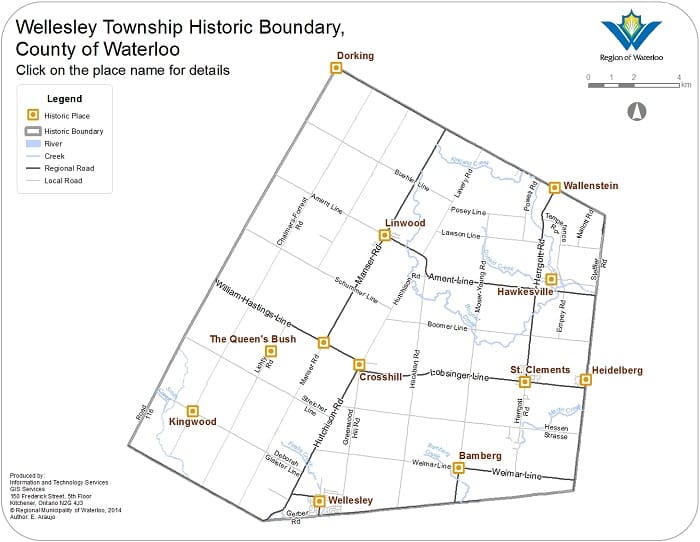
Of all five townships in Waterloo County, Wellesley Township was the last to be settled. In 1837, there were only 63 residents in the area; and by 1841, only 254.[1] Settlement of the Township was held back by the government which wished to see other townships of Waterloo County settled first. It was not until 1843 that the 66,910 acres of the Township were officially surveyed for settlement and placed for sale.[2] From this point forward, the Township was settled speedily; essentially, by the mid-1860s the Township was completely settled. The majority of settlers were of German heritage but other settlers were of Irish, English, and Scottish heritage as well. Moreover, settlers were predominantly of the Catholic and Lutheran faiths. Although a number of thriving communities with mills and other industrial enterprises would serve the township, farming would form the economic existence of the township. Wellesley Township was named for the eldest brother of the Duke of Wellington, Englishman Richard Wellesley, in 1840.[3] Wellesley held a number of honorary and administrative positions for the British Crown before his death in 1842, including Governor-General of India from 1798-1805.
Wellesley Township was an area of land contained within Clergy Reserves known as the Queen's Bush. The Queen's Bush was an expansive area which extended from Wellesley Township through to Lake Huron. It was controlled by the Crown. Subsequently, when settlement in the township began, settlers purchased lots from the government directly. Originally, the Crown had set aside Clergy Reserves for the preservation of the Protestant faith in Upper Canada. Although the population of the township was predominantly Protestant, there were also a large number of Roman Catholic settlers as well, approximately thirty per-cent of the total population by 1891.
Because the township had not yet been surveyed and opened for settlement when the first settlers arrived, these early arrivals simply helped themselves to the land and took up clearing the land and farming. Called squatters, they came from a variety of racial and religious backgrounds. The first squatters included a significant number of freed or escaped black slaves from the United States. In general, the Black settlers dispersed themselves throughout a host of areas within the Queen's Bush including Wellesley and Peel Townships which together had a Black population of between 500 and 900 by the time the first white settlers arrived.[4] An African Methodist Episcopal Church located in Peel served this black community in the 1840s.[5] Other squatters who settled in the township were primarily of German heritage. By the late 1830s, for example, a small number of these immigrants had settled in the southeast corner of the township in the Heidelberg and St. Clements locality. The earliest white settlers may have arrived as early as 1832.[6] However, until Wellesley Township was officially surveyed and placed on the market for settlement, little growth and development occurred in the area.
Wellesley Township was surveyed in 1843 by surveyor William Walker. To accommodate the small number of squatters who had already established themselves in the area, Walker divided the Township in two distinct blocks in congruence with what little development the squatters had already undertaken.[7] Squatters in the area met with varying degrees of success in regards to securing the now surveyed land where they resided. For example, those squatters who could afford to buy the land outright and make substantial improvements to it, did so immediately when approved by the government. In comparison, other settlers who could not afford to buy the land outright but who were willing to improve it, were allowed to make a series of payments for the land instead.[8] However, a number of both Black and white squatters of the Queen's Bush were denied grants altogether.[9] Some Black squatters moved from township lands to relocate elsewhere.[10] Other sold their labour as hired workers as a means to find an alternative source of income.[11] By 1850, the population of the township reached 3,396, but one year later it included only 46 Black settlers.[12] After the American Civil War concluded in 1865, many Black settlers returned to the United States.
For the most part, compared to that of many in the United States, Black squatters had bettered their situation in Upper Canada. However, when settlement in Wellesley Township began, obvious racial prejudices from both the government and settlers of Upper Canada prevailed.[13] For example, in the 1830s the government of Upper Canada made promises to Black settlers for land grants in the Queen's Bush, including Wellesley Township, if they remained loyal to the Crown by aiding in the suppression of the Mackenzie Rebellion of 1837.[14] These settlers however, would never receive the land grants which they were promised. Moreover, if Black settlers did receive land grants, they were usually located on the margins of developed areas where land was poor or too small to develop a sufficient farmstead.[15] It is also believed that many black squatters sold their claims to land in the Queen's Bush because they were either intimidated or threatened by white settlers who consequently purchased these lands for next to nothing.[16]

Wellesley Township Family Gathering, 1917 DHC 985.050.051
Once Wellesley Township was opened to settlement, it occurred very quickly. In general, the majority of settlers in the township were a mix of German, English, Irish, and Scottish. However, by far the majority of these settlers were German. By 1901, of the 5,051 inhabitants found in Wellesley Township, about 3,600 were of German heritage.[17] Some settlers arrived from townships elsewhere in the County, while others arrived from Europe directly. The majority of settlers were farmers but some took up trades and established a number of industrial ventures. Essentially, settlement in the whole of the township commenced and developed at relatively the same pace. For example, settlement occurred in the areas of Crosshill about 1843; Wellesley village about 1844; Hawkesville about 1846; and Linwood about 1846. In 1841, the population of the township was just 254; but by 1861 it had reached about 5,880. Throughout the remaining years of the nineteenth century, Wellesley Township would never attain a greater population than it had at this time. In fact, by 1891, the township had shrunk to a population of just 5,609; and by 1901, just 5,051.[18]
For the most part, the heaviest settlement of the township occurred near the borders of Wilmot and Woolwich Townships, and in the southeast corner near Waterloo Township. The larger communities of St. Clements, Wellesley, Heidelberg, and Hawkesville are evidence of this pattern. Several general explanations can account for this occurrence including the availability of water power in these areas; and the availability of supplies and social support which could be attained through contact with the nearby, previously settled townships of Waterloo County.

Fishing on the Nith River, May 24, 1913. DHC Research Files.
Wellesley Township attracted settlement for a variety of reasons. For example, settlers wishing to continue an agricultural existence were attracted to the area because it contained soils that were more than sufficient for farming. During the nineteenth century, like other townships involved in farming in Waterloo County, Wellesley Township supplied markets abroad with several prominent agricultural products including wheat and oats.[19] Some of the first settlers built sawmills which native timber supplied. By 1850, four sawmills existed in the township-the first one established about one mile north of Wellesley village by squatter John Scott in 1840.[20] As timber was cut and the construction of buildings and barns followed, communities took shape. Settlers also built industrial enterprises including flour mills, woollen mills, and chopping mills which further shaped the developing communities. For example, the first flour mill erected in the township was built by Hawkesville founder John Hawk in 1846.[21] A few years later, Hawk also founded the township's first woollen mill.

Wellesley Township Farmers, ca. 1910 DHC 994.067.014
A large number of developments undertaken in the township were influenced by Wellesley village resident and businessman John Reiner. Reiner was a native of Germany who arrived in Upper Canada in 1852.[22] After spending a number of years between Upper Canada and the United States, he finally settled in Wellesley village in 1866. Within a short span of time he had built thirty-two buildings in this area.[23] Included in this construction was a woollen mill, which he expanded annually, a flour mill, a sawmill, a stave and heading plant, and a section of a general store.[24] Moreover, he bought and ran a flour mill which the Doering brothers had constructed some years previous to his arrival in the community.
Although a number of similar industrial ventures developed throughout the township, compared to that of other townships in Waterloo County, industry in Wellesley Township was marginal. The township possessed few streams or bodies of water which could be harnessed for industrial power; the two most significant streams were the Nith River and the Conestoga River. Although these rivers were quite large, they hardly ventured beyond the southwest and northeast corners of the township respectively. Moreover, few significant tributaries to these rivers existed in the area. For this reason, it seems that Wellesley Township was naturally inclined to adopt farming as its primary economic base. Moreover, because Wellesley Township was the last to be settled in Waterloo County, other townships held an early advantage in regards to asserting themselves industrially, especially in terms of transportation routes including both roads and railways which usually accompanied or spurred development.
When settlement of Wellesley Township began, there were no existing roads.[25] Until European settlers built the current road system, they relied on earlier established trails and travel routes used by resident First Nations. When settlement began, settlers built roads by voluntary service. Until 1915, land owners were required to volunteer several days of Statute Labour each year to road construction.[26]
The township's first railway line was not laid until 1907,[27] a branch of the Canadian Pacific which traveled east and west through the township. It made stops at Linwood and Wallenstein and provided an important transportation link to areas abroad. However, because Wellesley Township was so late receiving this railway connection, it was excluded from the economic benefits of the railway boom of the mid-nineteenth century, from which other townships like North Dumfries and Waterloo had profited.
Catholic and Lutheran faiths were quite prominent in the township. The first Catholic settlers gathered for worship in the St. Clements area (then St. Alphonse) during the 1830s. Mass was first held and directed by the settlers themselves in their homes. The first Catholic priest to lead worship and mass in the township was a missionary named Father Wiriath, who first established a mission in St. Agatha. This mission became the nucleus of Catholicism in both the township and the county. Wiriath was a touring missionary preacher who made stops throughout Waterloo County where there were settlers of the Catholic faith or settlers whom he deemed in need of spiritual guidance and conversion. In 1840, the first Catholic church of the Queen's Bush was erected in St. Clements.[28] It was a log church administered by Father Schneider who had replaced Father Wiriath in St. Agatha several years earlier. The Jesuits arrived in St. Agatha between 1847 and 1852.[29] They opened worship in northern areas of Wellesley Township. In 1852, St. Clements received its first resident preacher, Father Messner.[30] From this point in time, St. Clements became the centre of Catholicism in Wellesley Township. It served communities including Baden, Crosshill, Heidelberg, and Hawkesville. In 1891, twenty-nine percent of Wellesley Township was of the Catholic faith.[31]
The earliest Lutheran worship services in the township took place in private dwellings. Some of the earliest Lutherans in the township were Hessian Lutherans from Germany.[32] This group settled in the area that became known as the Hesson Strasse. Early preachers were Reverend Wunderlich who arrived in 1848, and Reverend Hildebrand who arrived in 1851.[33] The first Lutheran church in the township, St. John's Evangelical Lutheran Church, was constructed in 1852.[34] In Wellesley village, the first Lutheran preacher to lead worship was Reverend F.W. Bindemann.[35] He was a touring preacher who made stops throughout Waterloo County as early as the 1830s. In Wellesley, St. Paul's Lutheran church was built in 1854.[36] In all, Lutheran Church members composed another twenty-nine percent of the township's populace by 1891.[37] Lutherans and Roman Catholics far out-numbered those of other faiths, including Presbyterians, Methodists, Mennonites and Anglicans.

Zion Presbyterian Church, Wellesley Township, ca. 1900. DHC 968.038.002
In summary, Wellesley Township was an area dominated by farming. By the late 1860s, the largest communities of the Township held populations of no more than about 400 each.[38] By the early twentieth century, communities had grown but little more. Wellesley was the largest community of the Township, with a population of only about 700; and Linwood of only about 450 inhabitants.[39] By comparison at the same time, the leading industrial centres of Waterloo County-Berlin and Galt-had populations of 11,500 and 8,700 respectively.[40] The larger communities of Wellesley Township remained centres of small scale trade and religious worship for the rural population in the villages and farms of the township.
[1] W.H. Smith, Canada: Past, Present and Future, Volume 2, (1851), 116, 117.
[2] Geoffrey Hayes, Waterloo County: An Illustrated History (St. Jacobs, 1997), 19.
[3] Alan Rayburn, Place Names of Ontario, (University of Toronto Press: Toronto, 1997), 366. See also: W.J. Wintemberg, "Origin of the Place and Stream Names of Waterloo County, Ontario," Waterloo Historical Society, (1927), 352-53; and G.H. Armstrong, The Origin and Meaning of Place Names in Canada, 1st ed. 1930 (Macmillan of Canada: Toronto, 1972), 298-99.
[4] Gerald Wright, "Fugitive Negro Slaves," Waterloo Historical Society, (1979), 26.
[6] Parsell, Illustrated Atlas of the County of Waterloo, (1881).
[8] Hayes, 19. Barbara J. Stewart, Phyllis Leleu Kitchen, & Debbie Dietrich, "A settlement History of Wellesley Township," The Maple Leaf Journal, (The Corporation of the Township of Wellesley: 1983), 27.
[10] Linda Brown-Kubisch, "The Black Experience in the Queen's Bush Settlement," Ontario History, LXXXVIII 2 (June, 1996): 110-12.
[11] Barbara J. Stewart, Phyllis Leleu Kitchen, & Debbie Dietrich, "A settlement History of Wellesley Township," The Maple Leaf Journal, (The Corporation of the Township of Wellesley: 1983), 27.
[12] Smith's Canada, Volume II, (1858). Also: Barbara J. Stewart, Phyllis Leleu Kitchen, & Debbie Dietrich, 27.
[13] Barbara J. Stewart, Phyllis Leleu Kitchen, & Debbie Dietrich, 25.
[14] Barbara J. Stewart, Phyllis Leleu Kitchen, & Debbie Dietrich, 27.
[15] Barbara J. Stewart, Phyllis Leleu Kitchen, & Debbie Dietrich, 25.
[17] Report on the Fourth Census of Canada, 1901.
[18] Census of Canada, 1890-91, (S.E. Dawson: Ottawa, 1893); and Report on the Fourth Census of Canada, 1901.
[20] E.W.B. Snider, "Waterloo County Forests and Primitive Economic," Waterloo Historical Society, (1918), 32.
[22] "John George Reiner: Autobiography," Waterloo Historical Society, (1917), 62-63.
[25] Barbara J. Stewart, Phyllis Leleu Kitchen, & Debbie Dietrich, 36.
[26] Barbara J. Stewart, Phyllis Leleu Kitchen, & Debbie Dietrich, 36.
[27] W.H.E. Schmalz, "Postal History of Waterloo County," Waterloo Historical Society, (1968), 54.
[31] Census of Canada, 1890-91, (S.E. Dawson: Ottawa, 1893).
[33] Barbara J. Stewart, Phyllis Leleu Kitchen, & Debbie Dietrich, 84.
[34] Barbara J. Stewart, Phyllis Leleu Kitchen, & Debbie Dietrich, 84.
[35] Barbara J. Stewart, Phyllis Leleu Kitchen, & Debbie Dietrich, 87.
[36] Barbara J. Stewart, Phyllis Leleu Kitchen, & Debbie Dietrich, 87.
[37] Census of Canada, 1890-91, (S.E. Dawson: Ottawa, 1893).
[38] Province of Ontario Gazetteer and Directory, C.E. Anderson &Co. (1869).


